# Financial KPIs Every CFO Should Track in 2026
Author: Nithish B
Author URL: https://blog.getcupi.com/author/nithish-b/
Published: 2026-06-24
Category: Writing
Category URL: https://blog.getcupi.com/category/writing/
Meta Title: Financial KPIs Every CFO Should Track in 2026
Meta Description: A practical guide to the financial KPIs that matter in 2026 from cash flow coverage to UPI reconciliation gaps. Built for CFOs running lean, fast-moving finance ops in India.
Tags: Expense Management, Financial KPIs, CFO Dashboard, Cash Flow Management, Payment Reconciliation
Tag URLs: Expense Management (https://blog.getcupi.com/tag/expense-management/), Financial KPIs (https://blog.getcupi.com/tag/financial-kpis/), CFO Dashboard (https://blog.getcupi.com/tag/cfo-dashboard/), Cash Flow Management (https://blog.getcupi.com/tag/cash-flow-management/), Payment Reconciliation (https://blog.getcupi.com/tag/payment-reconciliation/)
URL: https://blog.getcupi.com/blog/financial-kpis-cfo-should-track-2026/
Financial KPIs every CFO should track in 2026 to improve cash flow, control spending, and make smarter business decisions.
**A practical guide to the financial KPIs that matter in 2026—from cash flow coverage to UPI reconciliation gaps. Built for CFOs running lean, fast-moving finance ops in India.**
Most CFO dashboards are full of numbers. Few are full of the _right_ numbers.
In 2026, the gap between a CFO who reacts and one who anticipates comes down to metric selection. Not more reports better signals. Indian businesses are moving faster, payment rails are more complex (UPI, NACH, NEFT, vendor payouts all running in parallel), and the margin for error in cash flow visibility is shrinking.
This guide covers the financial KPIs that actually matter for finance heads running lean ops with concrete definitions, formulas, and benchmarks where they exist.
## **TL;DR**
- Cash conversion cycle is still the most under tracked metric in Indian mid-market finance.
- Advance payment utilization rate reveals how much working capital is sitting idle or unaccounted.
- Reconciliation lag the time between payout and matching is a leading indicator of audit risk.
- Burn multiple has replaced simple burn rate as the standard for capital-efficient SaaS and growth teams.
- Payment exception rate (failed, returned, or disputed UPI/NEFT transactions as a % of total) is a new must-track as digital payment volumes scale.
- Most CFOs track P&L well. Far fewer have real-time visibility into approval cycle time and spend-per-approval.
- The CFOs outperforming in 2026 are not just measuring outcomes they're instrumenting the workflows that create those outcomes.
## **Why Are CFO KPIs Changing in 2026?**
**Three forces are reshaping what finance teams need to measure:**
1\. Payment infrastructure complexity Indian businesses now run payouts across UPI, IMPS, NEFT, RTGS, and vendor-specific wallets often simultaneously. Each channel has different settlement timelines, failure modes, and reconciliation requirements. A single KPI dashboard that doesn't account for channel-level variance is giving you an incomplete picture.
2\. Decentralized spending With remote teams, distributed ops, and department-level budget ownership, spend is no longer controlled at a single choke point. Finance teams need metrics that work at the approval layer, not just at the ledger.
3\. Investor and board pressure on unit economics Post-2023, boards want to see efficiency ratios, not just growth. CFOs are being asked to report burn multiples, CAC payback, and gross margin by segment not just EBITDA.
## **What Are the Core Financial KPIs for CFOs in 2026?**
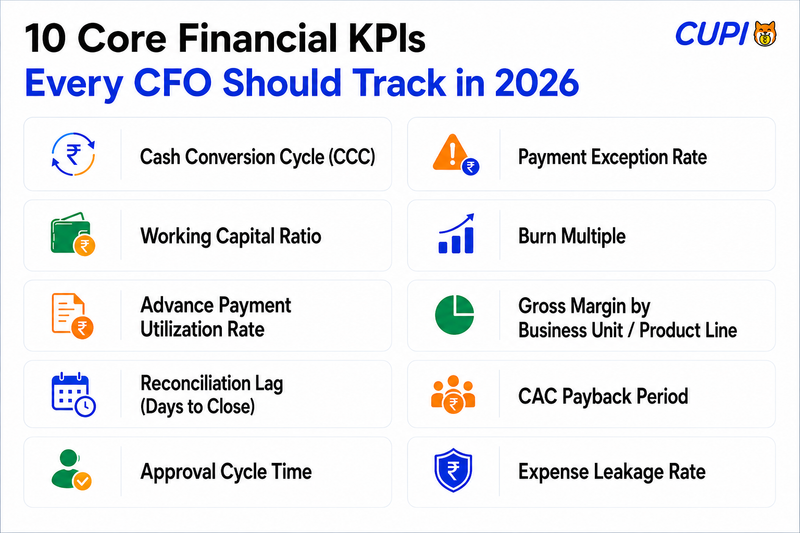A simple CFO KPI checklist for 2026 covering the key financial metrics businesses should track to improve cash flow, working capital, approvals, reconciliation, growth efficiency, and expense control.
### **1\. Cash Conversion Cycle (CCC)**
**Formula:** DIO + DSO − DPO _(Days Inventory Outstanding + Days Sales Outstanding − Days Payable Outstanding)_
Why it matters: CCC tells you how many days your cash is tied up between paying suppliers and collecting from customers. A shorter CCC means faster liquidity.
India-specific note: For B2B businesses running on milestone-based billing or advance-heavy contracts, DSO can be artificially compressed while actual cash risk is hidden in deferred delivery. Watch the underlying receivables ageing, not just the average.
Benchmark: Indian mid-market B2B companies typically run CCC between 45–90 days. SaaS businesses with annual contracts can run negative CCC (customer pays before service is delivered).
### **2\. Working Capital Ratio**
**Formula: Current Assets ÷ Current Liabilities**
**Why it matters:** Indicates short-term liquidity. A ratio below 1.2 in a business with lumpy payables (project-based, seasonal) is a yellow flag.
Practical nuance: Don't just track the ratio track its _velocity_. If working capital ratio is declining quarter-over-quarter even as revenue grows, you're scaling inefficiently.
### **3\. Advance Payment Utilization Rate**
**Formula: (Advances Settled / Advances Disbursed) × 100, within a defined period**
**Why it matters:** Cash advances and vendor prepayments are a significant working capital drain in Indian ops particularly for field teams, project-based businesses, and procurement-heavy functions. An advance sitting unreconciled for 30+ days is dead working capital _and_ an audit liability.
Red flag threshold: If more than 20% of advances disbursed in a quarter are still open at quarter-end, your advance management process has a structural problem.
What to instrument: Date of disbursement → date of first utilization → date of full settlement. That three-point journey tells you where advances stall.
### **4\. Reconciliation Lag (Days to Close)**
**Formula: Average number of days between a transaction occurring and it being matched/reconciled in the system of record**
**Why it matters:** Reconciliation lag is a leading indicator of:
- Month-end close quality
- Audit readiness
- Fraud and duplicate payment exposure
Benchmark: Best-in-class finance teams close reconciliation within 2–3 business days of a payment. Teams running manual reconciliation on spreadsheets often see 10–15 day lags meaning a payment made on the 28th might not be matched until mid-next-month.
UPI context: UPI transactions settle in near real-time, but reconciliation is only as fast as your matching logic. Volume + speed without automated matching = growing reconciliation backlog.
### **5\. Approval Cycle Time**
**Formula:** Average time (hours/days) from a spend request being raised to being approved and actioned
Why it matters: Approval bottlenecks are invisible in most P&L reports but have real operational consequences delayed vendor payments, missed procurement windows, field teams stalled waiting for funds.
What to track by segment:
- Vendor invoice approvals
- Employee advance requests
- Emergency/unplanned spend
- Recurring vs. one-time payouts
Benchmark: Sub-24-hour approval cycles for routine transactions are achievable with structured workflows. Multi-level approvals exceeding 72 hours for standard invoices are a process problem, not a people problem.
### **6\. Payment Exception Rate**
**Formula: (Failed + Returned + Disputed Transactions / Total Transactions) × 100**
**Why it matters:** As payment volumes scale, exception rate becomes a proxy for data quality, vendor master hygiene, and system reliability. A 3–5% exception rate on high-volume UPI payouts creates significant manual reconciliation overhead.
Root causes to audit: Incorrect VPA/account details in vendor master, insufficient balance at time of auto-payout, name mismatch on NEFT/RTGS.
What a 1% improvement means: On 10,000 monthly transactions, reducing exception rate from 4% to 3% saves 100 failed transactions each of which typically requires 20–45 minutes of manual resolution.
### **7\. Burn Multiple (Growth-Stage Companies)**
**Formula:** Net Burn / Net New ARR _(or Net New Revenue for non-SaaS)_
Why it matters: Burn multiple replaces the blunt instrument of "monthly burn" as the efficiency metric. A [company](https://blog.getcupi.com/blog/how-to-track-cash-advances-in-a-company) burning ₹2Cr/month to generate ₹1Cr in new ARR has a burn multiple of 2.0 generally considered the ceiling for efficient growth.
Benchmarks (David Sacks framework):
- Below 1.0 = Excellent
- 1.0–1.5 = Good
- 1.5–2.0 = Acceptable
- Above 2.0 = Needs attention
India note: Factor in GST timing differences and deferred revenue these can distort burn multiple calculations if your revenue recognition isn't clean.
### **8\. Gross Margin by Business Unit / Product Line**
**Formula: (Revenue − COGS) / Revenue × 100, segmented by unit**
**Why it matters:** Top-line gross margin is a vanity metric if you're cross-subsidizing a low-margin unit with a high-margin one. CFOs in 2026 need P&L visibility at the segment level not just company level.
Practical challenge in India: Many mid-market companies run shared services (finance, ops, HR) that get allocated differently depending on who's looking. Establish a consistent allocation methodology _before_ you start reporting segment margins.
### **9\. CAC Payback Period**
**Formula: CAC / (Monthly Revenue per Customer × Gross Margin %)**
**Why it matters:** For any business with acquisition costs, payback period tells you how long you're funding a customer before they become profitable. In high-churn environments, a payback period longer than 18 months is a structural risk.
CFO's role here: Marketing often owns CAC. Finance owns the accuracy of the gross margin inputs and the payback calculation. Don't let Marketing self-report their payback period without Finance validation.
### **10\. Expense Leakage Rate**
**Formula: (Unbudgeted + Unapproved + Duplicate Spend / Total Operational Spend) × 100**
**Why it matters:** Expense leakage spend that bypasses controls—is one of the most underreported problems in Indian SME and mid-market finance. It shows up in audits, not dashboards.
Common leakage points:
- Advances disbursed without purpose codes
- Recurring subscriptions never cancelled
- Duplicate vendor payments from split approvals
- Field spends with no receipts attached
Industry context: According to ACFE (Association of Certified Fraud Examiners), organisations lose an estimated 5% of annual revenues to fraud and leakage. [**(Source: ACFE Report to the Nations 2024)**](https://www.acfe.com/report-to-the-nations)
**Which KPIs Should Go on the CFO Dashboard vs. the Board Deck?**
**Layer**
**KPIs**
**CFO Operating Dashboard (weekly)**
**Reconciliation lag, Approval cycle time, Payment exception rate, Advance utilization rate**
**Finance Review (monthly)**
**CCC, Working capital ratio, Gross margin by unit, Expense leakage rate**
**Board / Investor Deck (quarterly)**
**Burn multiple, CAC payback, Revenue per FTE, Free cash flow**
The CFO operates across all three layers. The mistake is conflating them—putting burn multiple on your weekly ops dashboard or hiding reconciliation lag from your board when it's material.
**CUPI vs. Spreadsheets vs. ERP vs. Cards: How Do Finance Teams Track These KPIs?**
**Different tools give you different coverage. Here's an honest comparison:**
**KPI / Capability**
**Spreadsheets**
**ERP (Tally/Zoho/SAP)**
**Corporate Cards**
**CUPI**
**Advance utilization rate**
**Manual, always lagged**
**Partially, if coded correctly**
**Not applicable**
**Real-time, per-request**
**Reconciliation lag**
**High manual matching**
**Moderate batch processing**
**Varies by card issuer**
**Low automated matching at payout**
**Approval cycle time**
**Not tracked**
**Tracked if workflow enabled**
**Not tracked**
**Tracked per transaction**
**Payment exception rate**
**Not tracked**
**Partial**
**Partial**
**Tracked with failure reason codes**
**Audit trail per transaction**
**No**
**Yes (partial)**
**Statements only**
**Yes purpose, approver, timestamp**
**UPI-native payouts**
**No**
**No**
**No**
**Yes**
**Real-time spend visibility**
**No**
**Delayed**
**Partial**
**Yes**
[CUPI](https://www.getcupi.com/?utm_source=Financial%20KPIs%20Every%20CFO%20Should%20Track%20in%202026&utm_medium=Blog_3_Indirect) is a UPI-native spend control platform for Indian businesses. It handles approvals, purpose-coded payouts, reconciliation, and audit trails on a single workflow purpose-built for finance teams that need control at the transaction level, not just reporting at the month-end.
**What KPI Mistakes Do CFOs Most Commonly Make?**
**Tracking outputs, not workflows**
Most teams track revenue, costs, and margins well. Far fewer track the _process metrics_ that predict those outcomes: approval lag, advance open rates, reconciliation backlog. Fix the workflow metric before the outcome metric blows up.
### **Using averages where distribution matters**
An "average" approval time of 24 hours can hide a long tail of 5-day outliers that are causing real vendor friction. Track median _and_ P90.
### **No ownership assigned to each KPI**
A KPI without an owner is just a number. Every metric on your dashboard should have a named DRI (Directly Responsible Individual) and a defined review cadence.
### **Lagging indicators crowding out leading indicators**
P&L is a lagging indicator. Reconciliation lag, advance utilization rate, and payment exception rate are _leading_ indicators of financial health. Balance your dashboard accordingly.
**Conclusion: Build Your Dashboard Around Control, Not Just Reporting**
The CFO role in 2026 is as much about instrumented operations as it is about financial reporting. The teams winning aren't tracking more they're tracking _earlier_. They're catching reconciliation lag before it becomes a close problem. They're spotting advance utilization gaps before quarter-end. They're measuring approval cycle time before vendor relationships fray.
Start with the 4–5 metrics where you currently have the least visibility. Build reporting discipline around those first. Then expand.
Finance teams running on UPI-native infrastructure where payouts, approvals, and reconciliation happen on a single workflow are compressing close cycles and reducing exception handling significantly. That's the operating model worth building toward.
**Ready to instrument your finance ops?**
**_Stop managing payouts in spreadsheets. CUPI gives you UPI-native approvals, purpose-coded payouts, and automated reconciliation._** [**_Talk to the team today_**](https://cal.id/team/cupi-team/cupi-demo-session?utm_source=Financial%20KPIs%20Every%20CFO%20Should%20Track%20in%202026&utm_medium=Blog_3_Indirect%20) **_._**
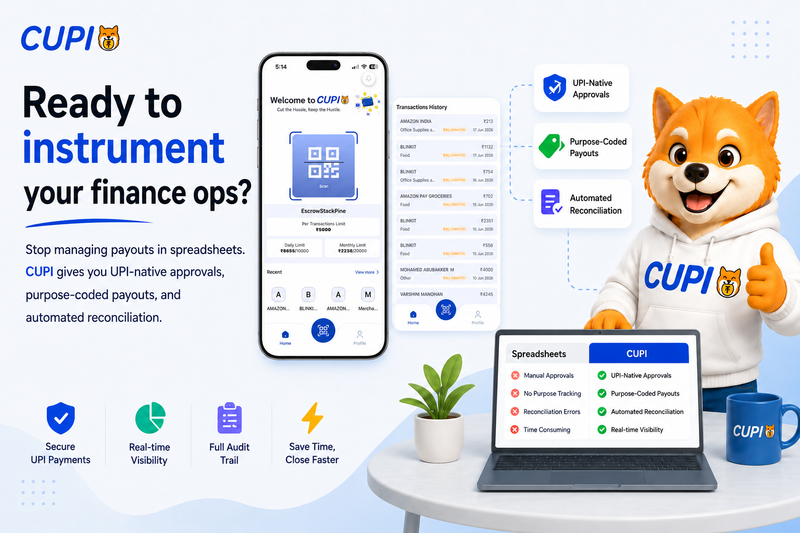
Ready to instrument your finance Ops?
## FAQs
Q: How many KPIs should a CFO track?
A: Most finance experts recommend 8–12 core KPIs across liquidity, efficiency, profitability, and control. More than 15 and you're tracking noise. Fewer than 8 and you likely have blind spots.
Q: What's a good benchmark for cash conversion cycle in India?
A: This varies significantly by sector. B2B services: 30–60 days. Manufacturing: 60–120 days. SaaS with annual prepayment: can be negative. The key is tracking directional change, not just absolute numbers.
Q: How do I track advance payment KPIs if we're still on spreadsheets?
A: At minimum, maintain a log with: disbursement date, amount, purpose, expected settlement date, actual settlement date, and status. Run a weekly open advances report. The manual overhead of this process is often the signal to move to a structured tool.
Q: Is burn multiple relevant for non-SaaS businesses?
A: Yes. Replace ARR with net new revenue. For project-based businesses, use contract value signed in the period. The ratio logic holds — you're measuring spend efficiency against growth generated.
Q: What's the difference between expense leakage and fraud?
A: Leakage is broader — it includes unintentional overspend, duplicate payments, and process gaps, not just deliberate fraud. Most leakage in Indian mid-market businesses is process-driven, not malicious.
Q: How should CFOs handle KPI reporting for multi-entity businesses?
A: Set KPIs at the consolidated level and the entity level. Reconciliation lag, for example, may be fine consolidated but broken in one entity. Entity-level visibility is essential for holding ops teams accountable.
Q: What's the role of UPI data in CFO reporting?
A: UPI transaction data — timestamps, beneficiary details, UTR numbers — is a rich data source for reconciliation, audit trails, and vendor payment tracking. Most CFOs aren't using it structurally. Tools that ingest UPI data natively give finance teams a significant edge in close speed.
Q: How do I tie KPIs to team accountability?
A: Map each KPI to a function owner. Reconciliation lag → Finance ops lead. Approval cycle time → Department heads + Finance. Burn multiple → CEO + CFO jointly. Build your review cadence around function ownership, not just the metric itself.
Q: What's the single most important KPI for an early-stage startup CFO?
A: Burn multiple. It's the cleanest measure of capital efficiency and the one metric that combines spend discipline with revenue growth.
Q: How often should CFO KPIs be reviewed?
A: Operational KPIs (reconciliation lag, approval time, exceptions) weekly. Financial KPIs (CCC, margins, burn) monthly. Strategic KPIs (CAC payback, unit economics) quarterly.
---
This blog is powered by Superblog. Visit https://superblog.ai to know more.
---