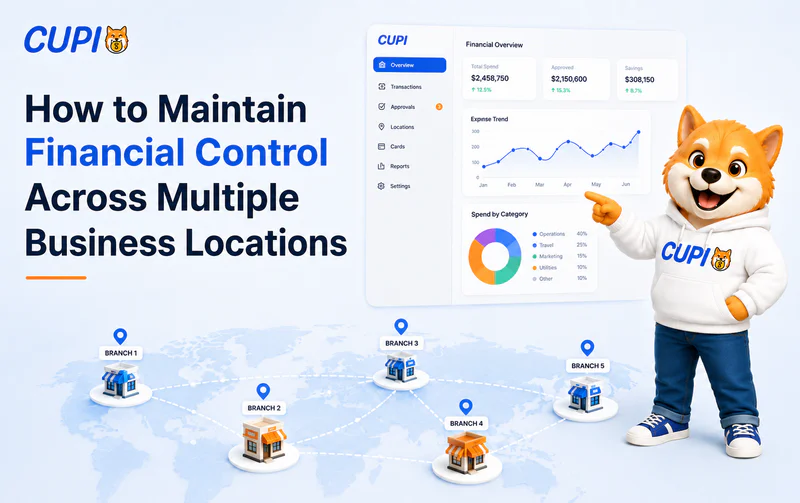
How to Maintain Financial Control Across Multiple Business Locations
What is CUPI?
CUPI is a UPI-based controlled payments platform that lets finance teams set spend rules, approve payouts, and auto-reconcile transactions across every branch, outlet, or field team, without handing out cash or corporate cards.
Running one office is hard enough. Running five, fifteen, or fifty is a different problem entirely.
When your business spans multiple locations, financial control stops being a policy question and starts being an infrastructure question. Who approved this payment in Pune? Why did the Hyderabad branch spend 40% more on vendor advances this month? Where is the receipt for that field team expense in Coimbatore?
Without the right systems, these questions do not have clean answers. And that gap, between what finance thinks happened and what actually happened, is where leakage, fraud, and audit failures live.
This guide breaks down exactly how finance heads, CFOs, and ops leaders in India structure financial control across multiple locations, what breaks without it, and what a practical framework looks like in 2025.
• Multi-location financial control fails most often at the approval layer, not the policy layer. Rules exist; enforcement does not.
• Every branch spending independently without a central visibility layer creates leakage that compounds at scale.
• The three things finance teams need at every location: a defined approval chain, real-time spend visibility, and automatic reconciliation.
• Cash and reimbursements are not financial controls. They are financial faith.
• Petty cash floats, informal vendor advances, and untracked field expenses are the three biggest blind spots for Indian multi-location businesses.
• Centralized payout control with UPI (via platforms like CUPI) makes it possible to enforce spend rules at the transaction level, not just at the policy level.
• A financial control framework for multiple locations has five layers: policy, approval, disbursement, tracking, and reconciliation.
Why Does Financial Control Break Down Across Multiple Locations?
A single-location business can rely on proximity. The finance manager sits ten meters from the person requesting a payment. They can ask questions, see receipts, and make judgment calls.
That model does not survive scale.
Here is what typically goes wrong when businesses expand to multiple locations without upgrading their financial infrastructure:
Approvals become informal.
Branch managers start approving their own expenses. WhatsApp becomes the approval system. The finance head finds out weeks later.
Cash floats multiply.
Each location runs its own petty cash float. Nobody knows the combined exposure. Replenishment requests arrive with vague breakdowns.
Vendor payments go uncontrolled.
Local vendors get paid directly from branch accounts or petty cash. No central record. No PO matching. No audit trail.
Reconciliation piles up.
Each location submits its own expense report, in its own format, on its own schedule. Finance consolidates manually. Errors accumulate.
Fraud is easier to hide.
The further a transaction is from the finance team, the easier it is to inflate, duplicate, or simply omit.
According to the Association of Certified Fraud Examiners (ACFE), small-to-mid-sized businesses lose an estimated 5% of annual revenue to fraud, with weak internal controls cited as the primary risk factor.ACFE 2024 Report to the Nations
What Does a Financial Control Framework for Multiple Locations Actually Look Like?
A framework is not a policy document. It is a set of systems that make the right behavior easier than the wrong behavior.
For multi-location businesses, that means five layers working together:
Layer 1: Policy (What is Allowed)
Define spend categories, limits, and approval requirements for each location type. A retail outlet in Tier 2 cities may have different norms than a sales office in a metro.
Document: per-transaction limits, category restrictions, vendor whitelist/blacklist, and escalation thresholds.
Layer 2: Approval (Who Authorizes)
Every payment above a defined threshold needs an approval chain. Not a verbal one. A documented, timestamped one.
Define: who can approve what amount, what the escalation path looks like, and whether multi-level approvals are required for certain categories.
Layer 3: Disbursement (How Money Moves)
This is where most frameworks fail. Even if policy and approvals exist, if money moves through cash or informal transfers, you have no control.
Controlled disbursement means money only moves when the approval is complete, within defined limits, and with an automatic record of what it was for. UPI-based payment platforms like CUPI let finance teams set these rules at the account level so every payout is automatically policy-compliant.
Layer 4: Tracking (What Happened)
Real-time visibility into what was spent, where, by whom, and for what. Not a weekly report. Not a month-end reconciliation. A live dashboard.
This is the layer that makes multi-location management manageable. Without it, you are always operating on stale information.
Layer 5: Reconciliation (Does It Match)
Auto-match payouts to approvals, invoices, and accounting entries. Flag exceptions. Close the loop.
Manual reconciliation across multiple locations is a full-time job that should not exist. Automation reduces it to exception handling.
What Are the Specific Financial Controls Multi-Location Teams Need?
Finance teams managing multiple locations consistently flag the same control gaps. Here is what the control layer needs to cover:
Spend Limits by Location and Category
Not every branch needs the same limits. A manufacturing unit has different operational expenses than a sales office. Set category-level limits per location type.
• Vendor payments: INR 10,000 per transaction, INR 50,000 per month
• Field expenses: INR 2,000 per day per person
• Office supplies: INR 5,000 per month per location
These are examples. Your limits depend on your business. The point is that they need to exist and be enforced at the disbursement layer, not just in a policy PDF.
Approval Chains That Match Your Org Structure
Single-level approvals work for small amounts. Anything above a threshold should require a second sign-off, ideally from someone outside the requesting location.
Example workflow:
1. Branch operations head requests vendor payment
2. Regional finance manager approves up to INR 25,000
3. Central CFO approval required above INR 25,000
A Real-Time Audit Trail
Every transaction should carry: who requested it, who approved it, what it was for, when it was paid, and to which account. This is not just for audits. It is for daily management.
Exception Alerts
When a location spends outside its category, exceeds a limit, or makes a payment to an unrecognized vendor, finance should know immediately, not at month-end.
Forced Reconciliation Before Replenishment
Before a location gets its next fund allocation, it should clear its outstanding balances. This single rule eliminates most informal carry-over issues.
How Does Centralized Financial Control Work Step by Step?
Here is what the workflow looks like when it is set up correctly:
4. Finance defines the rules centrally. Spend categories, per-transaction limits, approval chains, and vendor lists are configured once in a central system. All locations inherit these rules.
5. A location initiates a payment request. Branch manager or ops lead submits a request specifying amount, vendor, category, and purpose. The request is logged with a timestamp.
6. The approval chain runs automatically. Based on the amount and category, the system routes the request to the right approver(s). No WhatsApp, no calls, no chasing.
7. Approved payments are disbursed directly. Once approved, the payment is released via UPI to the vendor's account. No cash handling. No intermediate stops. The branch never touches the money.
8. Every transaction is auto-tagged and reconciled. The system tags the payment with the category, location, and approval reference. It auto-matches to the accounting entry. Finance sees it in real time.
9. Exceptions are flagged before they become problems. Any attempt to bypass the workflow, overspend a category, or pay an unlisted vendor is flagged immediately. Finance can investigate or override with a documented reason.
Real Use Cases: What Does This Look Like in Practice?
Use Case 1: Retail Chain With 20+ Outlets
A retail chain across Maharashtra and Karnataka was running petty cash at each outlet. Month-end reconciliation took the finance team four days. Discrepancies were common, but hard to trace.
With centralized UPI-based disbursements, each outlet request is approved by the area manager before payment hits. Reconciliation dropped from four days to automated daily matching. Discrepancies went from common to flagged in real time.
Use Case 2: Field Sales Team in 8 Cities
A B2B company had field sales reps across eight cities reimbursing their own travel and entertainment expenses. Claims were submitted monthly, receipts were incomplete, and approval was a rubber stamp.
Switching to pre-approved UPI payouts per trip meant reps requested amounts before travel, got approved digitally, and the payment went directly. No float, no reimbursement chase, no inflated claims.
Use Case 3: Manufacturing Unit With Multiple Vendor Payments
A mid-sized manufacturer was making vendor payments through branch bank accounts managed by local accountants. No PO matching, no central visibility.
Centralizing disbursements through a controlled payout system meant every vendor payment needed a PO reference and category tag before it could be approved. Duplicate payments dropped significantly.
Use Case 4: Restaurant Group With Central Kitchen + Multiple Outlets
Daily purchase payments to local vegetable and ingredient vendors were being handled in cash. Tracking was impossible. Prices varied by outlet with no explanation.
Moving to UPI-based pre-approved daily payouts standardized vendor payments, created a price benchmark per item across outlets, and flagged locations paying above the norm.
Use Case 5: EdTech Company With City-Level Operations
An EdTech company managing city operations through local city leads had no standard expense process. Each city lead handled their own vendor relationships and payment decisions.
Introducing a centralized approval and payout system with location-level budgets meant city leads could still manage operations but could not disburse without digital approval. The CFO got real-time budget utilization across all cities.
What Are the Most Common Mistakes Multi-Location Businesses Make?
Mistake 1: Treating Policy as Control
Writing down spend limits is not the same as enforcing them. A policy PDF in a shared folder is not a control system.
Mistake 2: Using Cash as an Operational Tool
Cash is untrackable at scale. Every rupee disbursed in cash is a rupee that leaves your control the moment it leaves your hand.
Mistake 3: Consolidating at Month-End
Month-end reconciliation means you are operating on information that is 30 days stale. By the time you catch a problem, it has compounded.
Mistake 4: Giving Branch Managers Bank Access
Shared bank accounts or debit cards at the branch level eliminate your central control. A branch manager with card access is a finance team of one with no oversight.
Mistake 5: No Escalation Path for Exceptions
When something falls outside the normal approval chain, there is no defined path. People improvise. Improvisation creates gaps.
Mistake 6: Ignoring the Vendor Layer
Approvals and spend limits are internal controls. But if vendors are not validated and payments are going to unverified accounts, internal controls are only half the picture.
CUPI vs. Cash vs. Reimbursements vs. Cards vs. Bank Transfers
Financial Control Checklist for Multi-Location Businesses
Use this before your next quarter starts:
□ Spend limits defined per location type and category
□ Approval chains documented and enforced digitally
□ No cash float above INR 5,000 per location (or lower where feasible)
□ All vendor accounts validated before payment
□ Real-time dashboard accessible by central finance team
□ Exception alerts configured for over-limit and out-of-category spend
□ Reconciliation automated or happening daily, not monthly
□ Pre-replenishment clearance rule in place
□ Branch managers have request access, not payment access
□ Audit trail complete: request, approval, disbursement, reconciliation
Conclusion
Multi-location financial control is not about trusting your team less. It is about building systems that make the right financial behavior automatic, regardless of which city, which branch, or which team member is involved.
The finance teams that scale well are not the ones with the toughest policies. They are the ones with infrastructure that enforces policy without friction, gives real-time visibility without manual effort, and closes the books without a week of reconciliation chaos.
Start with the framework: policy, approval, disbursement, tracking, reconciliation. Then look at where your current setup breaks down. That is where to build first.
Stop managing branches on faith. CUPI gives your finance team real-time control over every payout across every location, before money moves, not after. [Request a demo]